
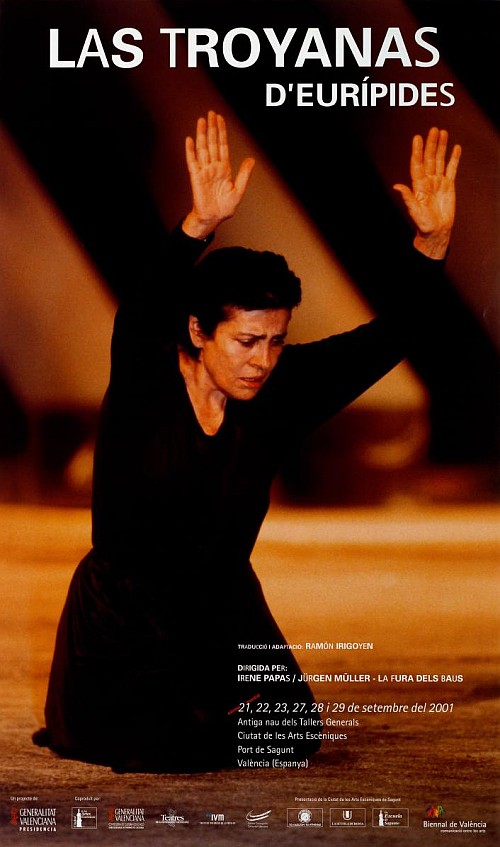
 Introduction
In 2001 Greek actress Irene Papas initiated the founding of a consortium of schools for the performing arts, allying three of the world’s most ancient cities, Sagunto (Spain), Rome (Italy) and Athens (Greece). The first play staged as part of this initiative was “Las Troyanas” (The Trojan Women), which is a Spanish adaptation of the classic tragedy by Greek playwright Euripides. Directed by Irene Papas, who also plays the lead role of Hecuba, Las Troyanas features original music by Vangelis.
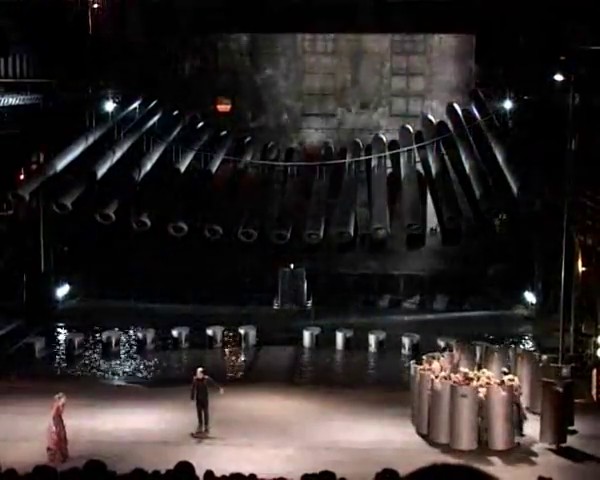
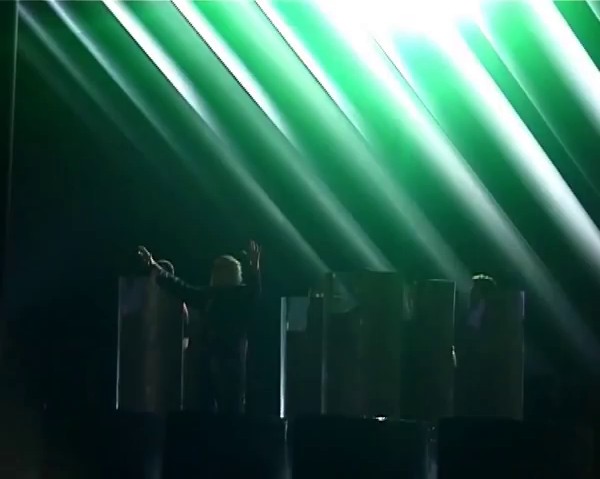
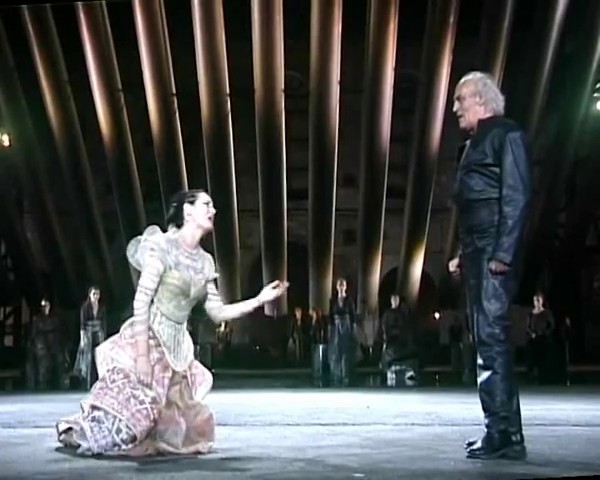
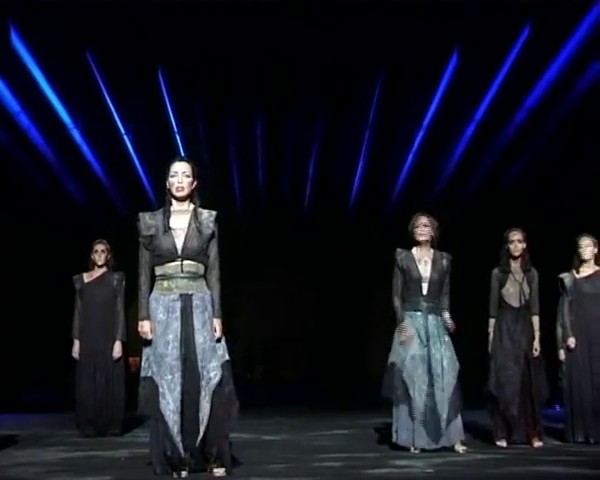
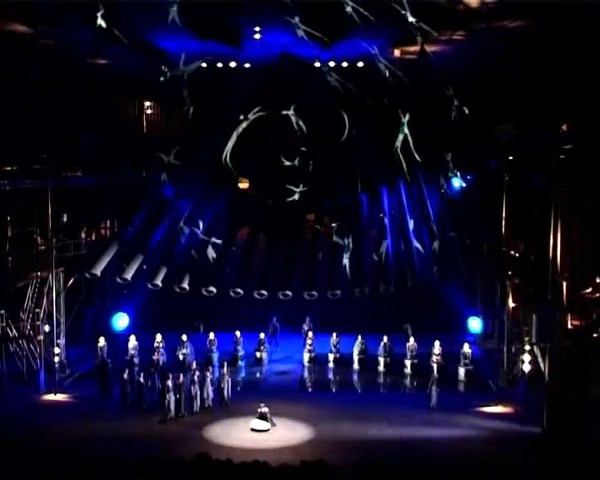
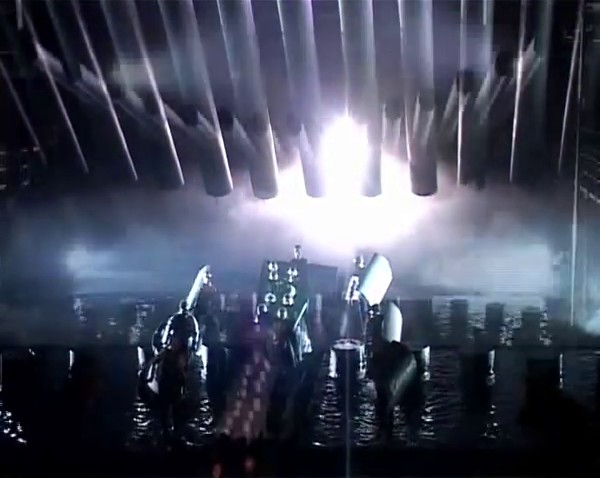
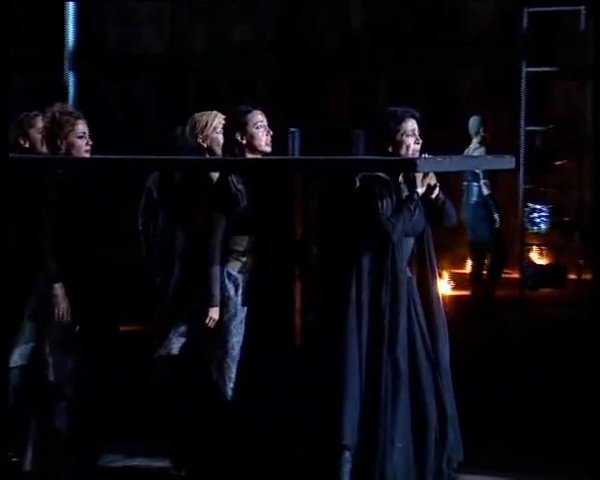
On the 21st of September 2001 Las Troyanas premiered in the presence of Queen Sofia of Spain in an old building of the former Altos Hornos steel factory in Sagunto (Spain), a coastal town near Valencia. The play was performed by the theatre group Fura dels Baus as part of the first Biennale of Valencia. Performances continued for one week, until September 29th 2001. Las Troyanas is a dramatic tale of the women of the city of Troy after its destruction during the Trojan war. Staged in an industrial building in the port of Sagunto, the play featured a stage with a construction of metallic tubes floating in the background, and a score by Vangelis which is appropriately dark and ominous. In 2003, two years after the performance in Sagunto, the play was re-performed at the Tor Vergata University of Rome as “Le Troiane”, together with “Ecuba”, another play by Euripides.
Although Papas had ambitious plans to open up another school in Athens and stage a third play (Agememnon by Aeschylus) during the Olympic Games in Athens in 2004, this unfortunately never materialised.
Other plays that Irene Papas staged or performed in for which Vangelis provided a musical score are:
- "Electra" (1983) performed at the Ancient Theatre of Epidaurus (Greece)
- "Medea" (1992) performed at the Greek Theatre in Barcelona (Spain)
- “Theodora And I” (1994) performed at the Odeon of Herodes Atticus in Athens (Greece) and at the Culturgest in Lisbon (Portugal)
- “Le Troiane ed Ecuba" (2003) performed at Tor Vergata University in Rome (Italy)
- "Antigone" (2005) performed at the Greek Theatre in Syracuse (Italy).
Irene Papas and Vangelis met in Italy in 1970, after which they became life-long friends. She contributed vocals on the Infinity-track of Aphrodite’s Child album “666” that same year and recorded two albums with Vangelis including Greek folk (Odes, 1979) and Byzantine music (Rapsodies, 1986).
 Details and credits
- Title: Las Troyanas
- Year: 2001
- Country: Spain
- Length: 90 minutes
- Directed by Irene Papas, Joan Cerveró and Jürgen Müller.
- Stage direction: Jürgen Müller
- Musical direction: Joan Cerveró
- Written by Euripides.
- Adaptation and translation by Ramón Irigoyen.
- Music by Vangelis.
- Scenography: Santiago Calatrava
- Video production: Paolo Barberis
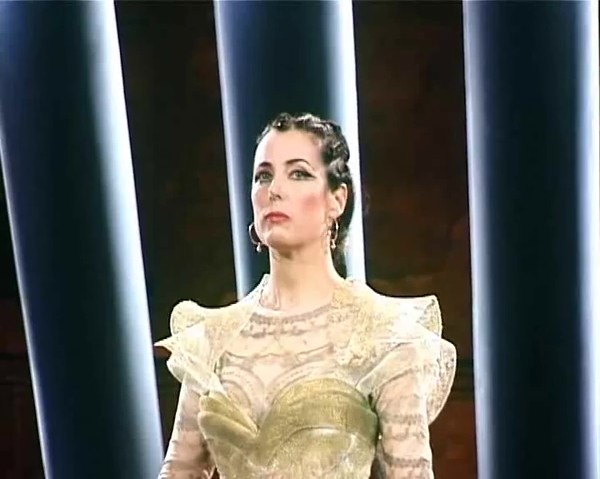
- Costume design: Marina Karella
- Lighting design: Joan Teixidó, Marco Carosi and Vittorio Storaro.
- Sound design: Marc Sardà
- Musicians: choir de la Generalitat Valenciana and singers of Cant d'Estil
- Produced by the City Of Performing Arts of Sagunto, Centre Coreogràfic de Teatres de la Generalitat, Institut Valencià de la Música (IVM), Teatres de la Generalitat and Generalitat Valenciana.
Cast
- Irene Papas - Hecuba
- Carles Figols - Talthybius
- Rosana Pastor - Cassandra
- Mónica López - Andromache
- Manuel de Blas - Menelaus
- Mía Esteve, Marina Saura - Helen
- Edo García - Astyanax
- Maurizio Donadoni - Polimestor
- Jacobo Cinque – Ghost of Polydorus
- Carlo Astuti - Neoptolemus
- Michele Munali and Antonio Tomasi - children of Polimestor
- Chorus: Amparo Fernández, Ata Gomis, Pepa Juan, Lola López, Cristina Plazas and Consol Soler.
- Dancers: Sara Baixauli, Mª Luisa García, Lara Hernandorena and Leticia Ñeco.
- Cant d'Estil singers: Marisa Ruiz, Teresa Segarra, Victoria Sousa and Empar Torres.
Performances
- September 21, 22, 23, 27, 28, and 29th 2001.
 Media
Media
The performance of Las Troyanas was recorded on video, given the availability of several short online videos, but a recording was never officially released.
Links
- La Fura dels Baus
- Las Troyanas online videos 1 / 2
- Eyewitness report
Gallery
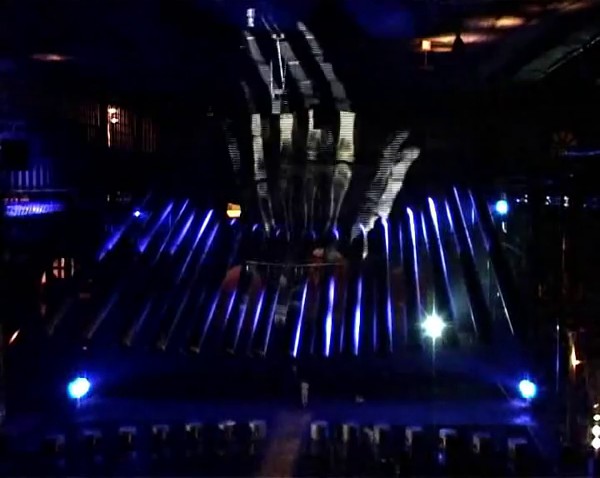 |
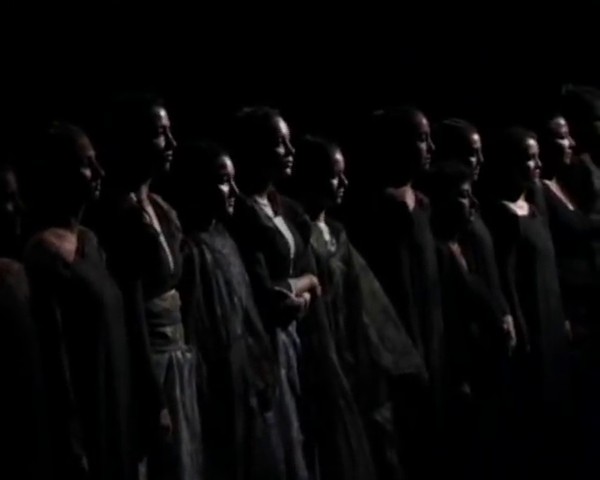 |
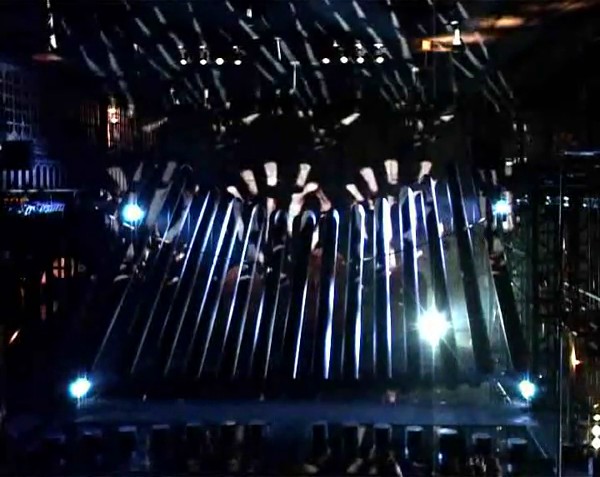 |
 |
 |
 |
 |
 |
 |
 |
 |
 |
 |
 |
 |
|